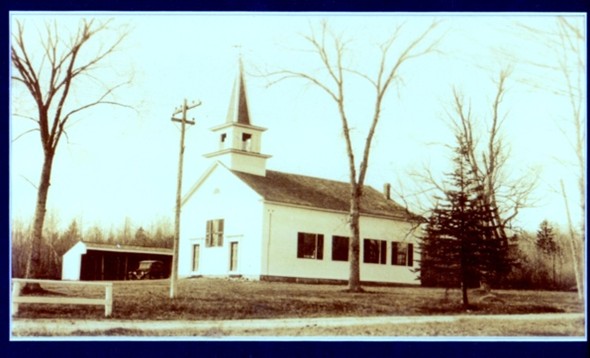
In his History of Baptists in Maine, Joshua Millet wrote in 1845 that, on April 29, 1806, twelve members did “gather a church in Belgrade”. Elder I. Case was the first preacher, followed by Asa Wilbur, Gould, Joseph Palmer, Moses Low, Kendal and Benjamin Bishbee. By 1810, Elias Taylor was ordained as pastor, and in 1826 land was purchased “in consideration’ of ten dollars from Shadrack Rollins and Moses Page. Later in 1826 this Calvinist Baptist society began to build the meeting house still standing at Rockwood’s corner of the Winthrop road and the West Road. It was dedicated on July 18th, 1828.
Following a time of discord, Pastor Taylor resigned in 1833, and by 1839 attendance had “so far declined and become so disunited as to be not in a state worthy of the ante of a real church.” The few members then formed as a society and applied to the Kennebec Association of Baptists for assistance. Rev. Daniel McMaster was minister for the next three years, followed by Rev. Lucius Packard, Deacon A.W. Cummings and Benjamin Jackson. Later history of this church can be read in the 1978 booklet published by the Ladies Aid Society of Old South Church. An old record book tells of a South Belgrade Freewill Baptist Church that organized September, 1848, and voted that conferences be held at the Baptist Meeting House at Rockwood’s Corner.
By the next year, this church voted those conferences be held half the time at Rollins school house, at the corner of Wings Mills road. Later the Axtell school house (District 4) on the Knowles Road, was the place of meeting. Asa Axtell was a member here, and was a member earlier of the Calvinist Baptist Society, builders of Old South Church. Records cease in 1858 with the notation “few in attendance.” According to early records, sometime before 1802 a freewill Baptist church met in the Dearborn area (part of which is now North Belgrade) and “on the back side of Great Pond.” This group continued for more than ten years, meeting in homes of Cornelius Tilton and Benjamin Frost, in Asa Libby’s barn, and in “the schoolhouse near Capt. Jones’ house,” District 9 at the junction of the West Road and the Gowell Road. Elias Taylor was the pastor in 1814. Preceding this, a small Society of Friends (Quakers) had formed here as early as 1801, led by Calvin Stewart, Samuel Stewart and Eleazer Burbank, who was later dropped for receiving a military pension. Samuel Taylor was their first minister. By 1939 a small meeting house was built at the southwest corner of the present Friends’ burying ground at the junction of the Oakland road and the Winthrop Road. Fourteen years later, ox teams hauled this meetinghouse to a “site near Frank Pray’s house” and the group met there several more years. Finally, the meeting house was sold to Joseph Taylor for use as a barn and it burned in 1880. An 1856 map of Belgrade locates a church building on the west side of the Oakland road, halfway between the Friends’ cemetery and the road junction at the top of Belgrade hill. This could have been later the site of this Friends’ Meeting House.
Further north, at the top of Belgrade hill and on the east side of the road, a Unitarian and Freewill Baptist church was built in 1827. John Pitts and Samuel Titcomb contributed much toward its cost of $1300. Titcomb Academy was built just east of the meetinghouse two years later and burned in 1885. William Farmer and Samuel Hutchins were two of the early preachers in this unheated meetinghouse. Attendance lessened, and by 1885, by a special act of the state legislature, the building was torn down. Benjamin Gleason bought the timbers for his barn in Oakland.