
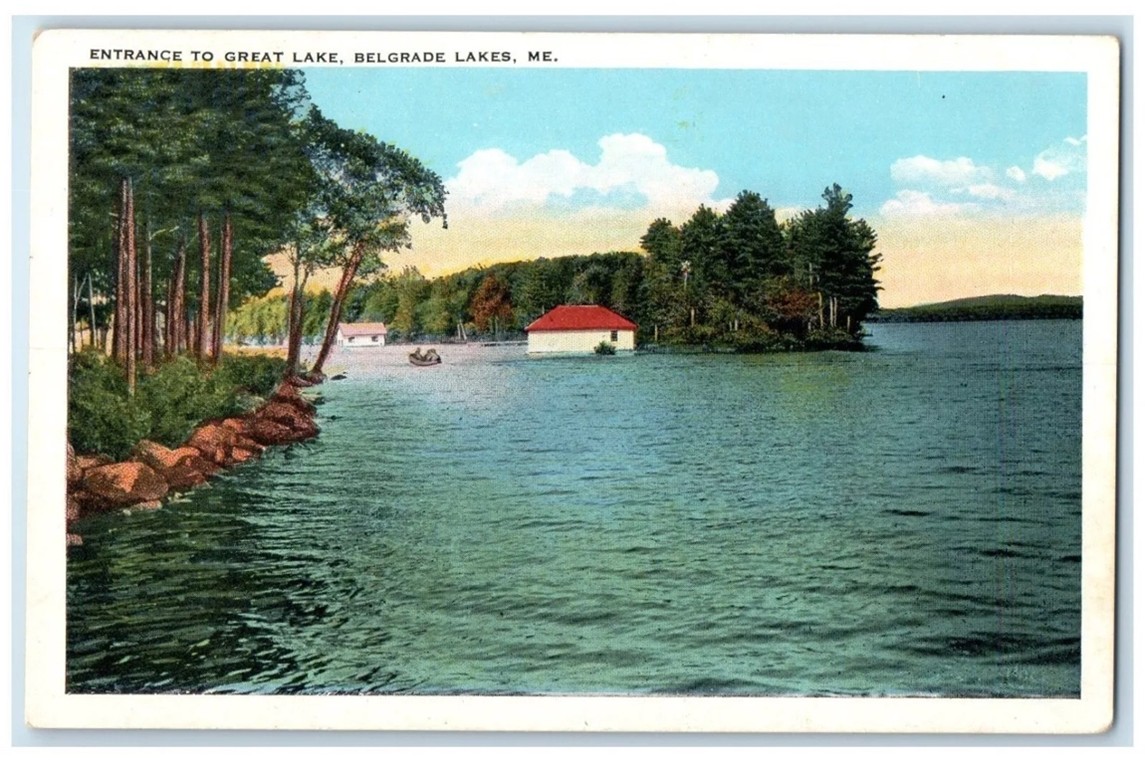
L.L. Bean’s former camp at the entrance to the Mill Stream on Great Pond
Eric Hoogland, our past BHS board member and curator, led historical walking tours in the village for years. Below is a reprint of an earlier history of L.L. Bean’s relationship with the town. During these tours, inevitably at least one person participating in these tours asks whether we would be seeing the camp of the legendary retailer L.L. Bean (1872-1967). I tell the group that, although L.L. Bean’s former camp—a nice cottage, actually—still exists, it is not in the village and can’t be seen on a walking tour. Rather, it is on Great Pond, right astride the point of land that marks the beginning of the Mill Stream.
The stream flows from Great Pond and into Long Pond through the dam at the northern end of the village. And then I tell the participants that L.L. Bean had a younger brother who did not achieve international fame but was very important as a tourism entrepreneur right here in Belgrade Lakes during the first half of the twentieth century. And they will be seeing a lot of his former property on this walking tour! That brother was Ervin A. Bean.
Much of what we know about the history of Ervin Bean (1876-1940) comes from the narrative he told a summer visitor to Belgrade Lakes in 1923. That man, Edward Mott Woolley, lived in New Jersey and was a popular author and journalist who, from 1923 to 1925, wrote a series entitled “Romances of Small Business” that were syndicated weekly in newspapers. In the BHS archives, we have a copy of the one he wrote about Ervin Bean. This copy originally appeared on p. 6 of New Brunswick, NJ’s The Central New Jersey Home News for November 14, 1923. According to Mott, everywhere in that vicinity [Belgrade Lakes region] I heard people speak of Bean’s store … No matter what anyone wanted, he went to Bean for it— from groceries and patent medicines to bait. Bean seemed to dominate the business of the place. So, it looked as if Bean was worth a story—and he was. Mott ‘interviewed’ Ervin Bean and wrote his story by quoting him directly in the article. Here is what Bean had to say: “I was born in Maine on a farm. My father and mother died and were buried on the same day, and I, the second youngest, was sent to live among strangers on another farm.
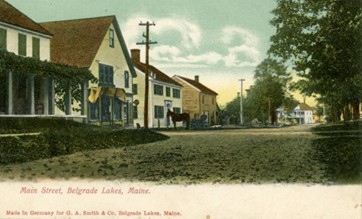
Postcard, ca.1910, showing Ervin Bean’s store, 2nd building on right.
I was six years old. My schooling was very limited, and the farm work grinding. At sixteen, I left school for good and engaged myself to a farmer for $200 a year. Then I worked in a general store at $7.50 a week and quit that to enlist in the Spanish War.” [Spanish-American War of 1898] “When I came home, I started a little furnishing store at Freeport, Maine, and kept it going for five years, quitting to take a job on the road selling fishing tackle for a New York house. Belgrade Lakes was on my route—and there you have it. I liked the place, and made up my mind it would be a good summer region, and a good place to start a business in. That was thirteen years ago.” [In1910]. Ervin Bean purchased Bert Kelly’s sporting goods store on Main Street (see photo below).
Originally, Charles Austin of the Central House had built it in 1890 as a general store for his daughter Jennie and son-in-law Harvey Parker, but by 1910 Kelly owned it. Bean transformed it into a store catering to the tourists. [Note that this was 2 years before his older brother, L.L. Bean, founded his famous boot company in Freeport!] He told Mott: “My greatest early problem was to find out what people wanted, and, having found out, to get these goods. It was hard to adjust a proper outfit [for fishing], and to give my customers prompt service. But I attribute my success to the accomplishment of all these things.” (He also told Mott that he had “sales of $75,000 a year in the store”).
Bean sold all the fishing gear, bait and sports goods tourists wanted, as well as the groceries they needed and the tourist trinkets and souvenirs they desired as mementos of their summer vacations. And for his customers’ children, he installed a marble top soda fountain in the back of his store! And he branched out. The first motors to fit on boats appeared in 1910, and soon Bean also was operating a profitable business of renting powerboats on a site near the dam on Mill Stream. The increasing numbers of tourists sparked his entrepreneurial spirit, and he bought the former residence of Henry Golder—the 1843 white house with the distinctive widow’s watch on its roof—and operated it as the Lake View Manor guesthouse, complete with a famous dining room where guests could eat breakfast, lunch and dinner while looking out at Long Pond (see photo and ad below). He also acquired the white house next to it—currently the home of Balloons n’ Things gift shop—which became The Cottage annex to the Lake View Manor.