
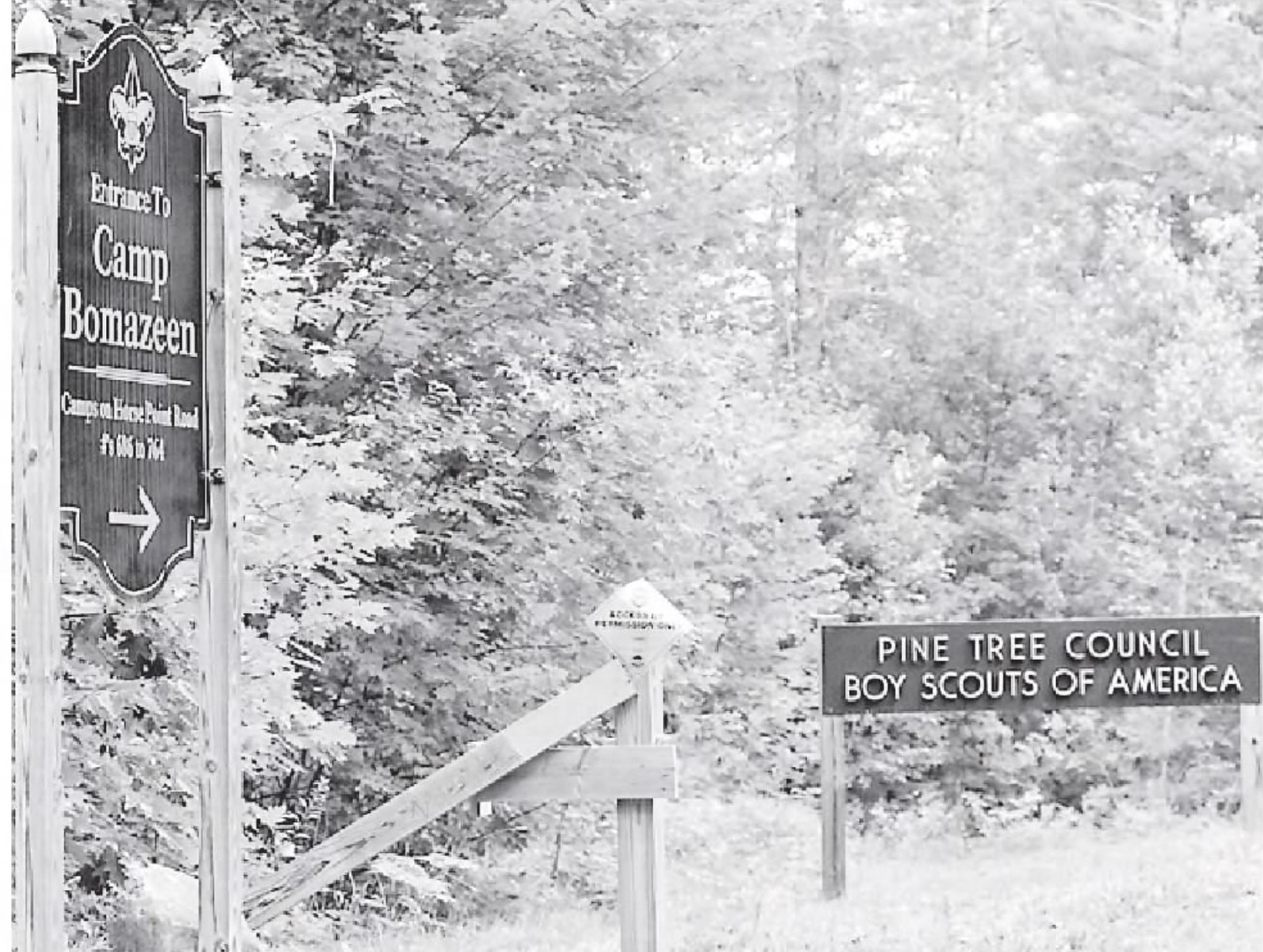
Camp Bomazeen is located on the eastern shore of Great Pond in Belgrade Lakes and has operated for nearly eighty years as an important youth camp in central Maine.
The camp formally opened in 1945 as a Boy Scouts of America camp. Its dedication drew Scouts from ten counties across Maine, reflecting its intended role as a regional facility for the Pine Tree Council. At the ceremony, Scout Executive Perri Dunn presented two flags to the camp, which were accepted by William Hinman of Skowhegan on behalf of the trustees.
The property was made available through the generosity of Dr. and Mrs. George G. Averill of Waterville, who provided land along Great Pond’s eastern shoreline. Their gift, combined with the work of the trustees, allowed the camp to open that same summer.
The name “Bomazeen” comes from a Native American chief whose people once camped in Norridgewock, linking the camp to the longer Indigenous history of the region.
For decades, Bomazeen has functioned as a Boy Scout summer camp where Central Maine Scouts participated in traditional Scout activities such as canoeing, swimming, hiking, navigation, first aid and woodcraft. The program emphasized outdoor skills, teamwork, and leadership development, with Great Pond serving as the central setting for waterfront and wilderness activities.
By 1979, the camp was also serving younger Scouts: the northern end of Bomazeen was used for a dedicated Cub Scout program, expanding its reach to younger boys for a day campers.
The Pine Tree Councils has faced financial pressures over time which has impacted Bomazeen. In 1979, and again in 2020, the Pine Tree Council considered selling the property as a way to reduce council debt. In both cases, the possibility of a sale generated significant concern among alumni, local residents and families connected to the camp.
Despite these challenges, Camp Bomazeen has continued to operate. Facilities have been updated over time, programming has broadened and the camp eventually became coeducational. While operations have evolved, the core mission — providing outdoor education and recreation on Great Pond — has remained consistent.
Today, Camp Bomazeen continues to be an active summer camp and an important part of the history of the Belgrade Lakes region, representing both the legacy of postwar Scouting in Maine and the continuing tradition of youth camps on Great Pond.
By the next year, this church voted those conferences be held half the time at Rollins school house, at the corner of Wings Mills road. Later the Axtell school house (District 4) on the Knowles Road, was the place of meeting. Asa Axtell was a member here, and was a member earlier of the Calvinist Baptist Society, builders of Old South Church. Records cease in 1858 with the notation “few in attendance.” According to early records, sometime before 1802 a freewill Baptist church met in the Dearborn area (part of which is now North Belgrade) and “on the back side of Great Pond.” This group continued for more than ten years, meeting in homes of Cornelius Tilton and Benjamin Frost, in Asa Libby’s barn, and in “the schoolhouse near Capt. Jones’ house,” District 9 at the junction of the West Road and the Gowell Road. Elias Taylor was the pastor in 1814. Preceding this, a small Society of Friends (Quakers) had formed here as early as 1801, led by Calvin Stewart, Samuel Stewart and Eleazer Burbank, who was later dropped for receiving a military pension. Samuel Taylor was their first minister. By 1939 a small meeting house was built at the southwest corner of the present Friends’ burying ground at the junction of the Oakland road and the Winthrop Road. Fourteen years later, ox teams hauled this meetinghouse to a “site near Frank Pray’s house” and the group met there several more years. Finally, the meeting house was sold to Joseph Taylor for use as a barn and it burned in 1880. An 1856 map of Belgrade locates a church building on the west side of the Oakland road, halfway between the Friends’ cemetery and the road junction at the top of Belgrade hill. This could have been later the site of this Friends’ Meeting House.
Further north, at the top of Belgrade hill and on the east side of the road, a Unitarian and Freewill Baptist church was built in 1827. John Pitts and Samuel Titcomb contributed much toward its cost of $1300. Titcomb Academy was built just east of the meetinghouse two years later and burned in 1885. William Farmer and Samuel Hutchins were two of the early preachers in this unheated meetinghouse. Attendance lessened, and by 1885, by a special act of the state legislature, the building was torn down. Benjamin Gleason bought the timbers for his barn in Oakland.